Banneton Size Guide: How Much Dough for Your Basket?
Banneton size guide: how much dough fits a 25 cm round or 10 inch oval proofing basket, how to scale recipes, and what happens if you over or under fill.
The rule of thumb
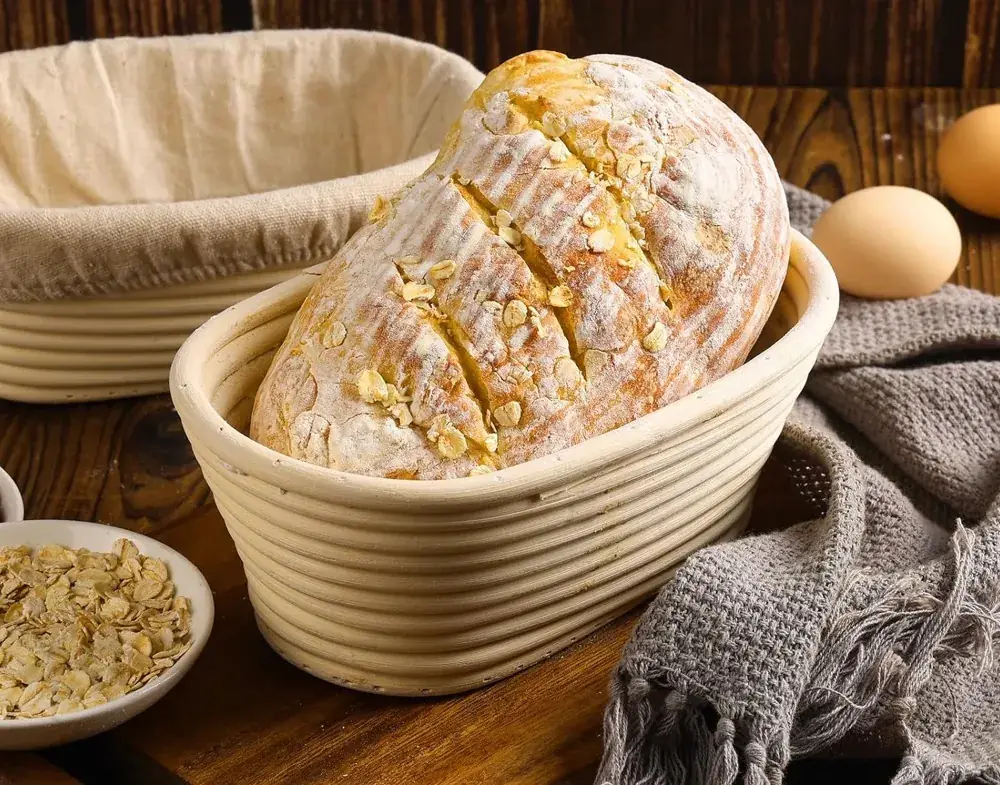
Shaped dough should fill the basket roughly half to two-thirds of the way up before proving. That leaves room for it to rise without spilling over the edge, while giving enough support to keep the loaf tall.
How much dough fits a Bannette basket?
| Basket | Size | Dough weight |
|---|---|---|
| Round | 25 × 25 × 8.5 cm | About 700 to 900 g (1.5 to 2 lb) |
| Oval | 10 in / 25 cm long | About 700 to 900 g (1.5 to 2 lb) |
"Dough weight" means the total weight of everything in the dough: flour, water, starter and salt. A typical recipe with 500 g of flour lands at around 850 to 950 g of dough depending on hydration, which sits right at the top of the range. A recipe with 400 to 450 g of flour fits comfortably.
Scaling a recipe to fit
If your recipe makes one big loaf of 1 kg or more, you have two easy options:
- Split it between both baskets. Bannette sets come as a pair, so divide the dough after the bulk ferment and make two smaller loaves.
- Scale the recipe down. Multiply every ingredient by the same number. For example, to turn 1,000 g of dough into 850 g, multiply everything by 0.85.
What if I over or under fill?
- Too much dough: it rises over the rim, sticks to the cover and loses its neat shape when turned out.
- Too little dough: the loaf has less support and may spread a little more. Still perfectly good bread, just a bit flatter.
Frequently asked questions
What size banneton do I need for 500 g of flour?
A 25 cm round or 10 inch oval banneton suits a loaf made with 500 g of flour. That's the most common home recipe size.
Can I put 1 kg of dough in a 10 inch banneton?
It's usually too much and may overflow as it proves. Split it between two baskets instead.